Tuesday, June 2, 2015

The Biblicality of the Rosary

INTRODUCTION

What’s more Catholic than the rosary? One of the most iconically papist images also happens to be one nowhere found in the Scriptures, a fact which our separated brethren seldom fail to point out. How can we justify this old yet often unclear practice? What does the rosary have to do with the Bible?

First of all, the rosary itself should be explained. Simply put, it is a set of prayers said using a cord with beads, the beads numbering the prayers. The main prayers used are the Lord’s Prayer and the Hail Mary. These prayers are used to meditate on different events, or “mysteries,” from the lives of the Virgin Mary and Christ. These mysteries are divided into three or four groups of five each, and are marked by ten Hail Marys, or a decade.

I shall now attempt to systematically unpack the Catholic beliefs that support the prayer of the rosary, and build a Scriptural defense of this method of prayer. Along with biblical references, it should include insight from Popes, Councils, Saints, and Catholic figureheads from history.


THE PROPER PLACE OF MARY AND THE SAINTS

Many find the very idea of praying to anyone but God problematic. The crucial part of this issue is the definition of prayer. While many assume prayer implies worship, this does not have to be the case. There is a certain kind of worshipful prayer that is reserved for God alone, but, when understood correctly, prayer can be given to any saint or angel. Prayer, as Christians have always understood it until relatively recent times, simply means speaking with one’s soul. As one uses the body to communicate with others who have bodies, one must use the soul to communicate with those who are pure spirit. There is no element of worship here, in fact it may differ very little from communicating with our fellow men. Why, for instance, would our God give us a guardian angel that he would forbid us from communicating with?

Intercessory prayer, asking someone to pray to God for them, is the most common form of prayer to saints and angels. Some may say that this is wrong on the grounds that “there is one mediator between God and men, the man Christ Jesus.” But don’t we then defy this verse every time we ask a friend or family member to pray for us? Being a part of the Body of Christ, which all Christians, whether on Earth or beyond, are included in, we have the privilege to not only ask for prayers from our earthly friends, but from those in Heaven and Purgatory as well. In doing this, we do not seek a way around Christ, but rather an enriched prayer through Christ. “There is no reason why certain others should not be called in a certain way mediators between God and man, that is to say, in so far as they co-operate by predisposing and ministering in the union of man with God.” If you value the prayer of a holy person you know, how much more should you value the prayer of one who can see the face of God!

One might ask why we should believe that saints can hear our prayers at all. Yet in the Scriptures we find:
“the four living creatures and the twenty-four elders … with golden bowls full of incense, which are the prayers of the saints … and another angel came and stood at the altar with a golden censer; and he was given much incense to mingle with the prayers of all the saints upon the golden altar before the throne; and the smoke of the incense rose with the prayers of the saints from the hand of the angel before God.”
So we see that the saints are laying prayers before God, and the prayers indeed seem to be those of others. After telling of the heroes of the Old Testament, Paul tells us “we are surrounded by … a cloud of witnesses,” implying that those who are departed in Christ are still aware and active in the events on Earth. Also, because those in Heaven are undoubtedly in the presence of more grace than we on Earth could conceive to receive, God would most likely let us take full advantage of our heavenly brethren through their intercession. After all this, it is reasonable to assume that those in Heaven do, in fact, hear our prayers, and act on them.

It is true we hold Mary in a higher place than all other saints, in fact, as the highest creature in existence. But is this unjust, given that we hold her as Mother of God, conceived without sin? The Marian Dogmas are not the topic of this paper, so I will assume them to be accepted. Suffice to say that it makes much sense that our savior would want to create a perfect vessel for his entry into salvation history, and she deserves the praise and veneration that we as Catholics give her. “This very special devotion...differs essentially from the adoration which is given to the incarnate Word and equally to the Father and the Holy Spirit, and greatly fosters this adoration.”


THE NATURE OF PRAYER TO MARY

Mary is not only the mother of Jesus Christ, but the spiritual mother of the whole Church. When Christ tells Mary “Woman, behold, your son!” and John, “Behold, your mother!” He gives Mary not just as a mother to John, but to all of us. So we can see that:
“We are indebted to Christ for sharing in some way with us the right, which is peculiarly His own, of calling God our Father and possessing Him as such, we are in like manner indebted to Him for His loving generosity in sharing with us the right to call Mary our Mother and to cherish her as such.”
As her spiritual children, we can request spiritual aid of her as a child requests physical aid of a mother. We are not nurtured at her breast as Christ was, but we are allowed to be nurtured by her grace through the same Christ’s mercy.

Christ Himself, being a loving Son of his human mother, is ever present to her desires, making her intercession extremely powerful. Many surely have been saved through the intercession of Mary who otherwise would have failed to reach that goal.
“All men, moreover, are filled with the hope and confidence that petitions which might be received with less favour from the lips of unworthy men, God will accept when they are recommended by the most Holy Mother, and will grant with all favours.”
We can thus conclude that Mary should not only be a model of perfect holiness for us, but a figure of maternal compassion, who we can know personally through prayer and petition. She, of course, desires the union of all people to her Son, and will with no doubt fly to the aid of any who ask her for it. With both the imitation of her, and her personal intercession, we have an unstoppable force for the salvation of souls.
“God has established for us a most suitable example of every virtue [Mary] … If we, with her powerful help, should dedicate ourselves wholly and entirely to [imitating her], we can portray at least an outline of such great virtue and sanctity, and reproducing that perfect conformity of our lives to all God's designs which she possessed in so marvelous a degree, we shall follow her into heaven.”

THE PRAYERS OF THE ROSARY

As for the rosary itself, it is a perfect application of these Marian truths. It is both a supplication and a meditation. It uses all parts of one’s being:
“Now the rosary...has a beautiful combination…First of all, it is vocal; we say some prayers with our lips. Secondly it’s mental, because as we say, for example, the Hail Mary, we are not so much concentrating on the Hail Mary; we are thinking about the mystery...Then in addition to the mental (the prayer, the thought), and the vocal (the prayer itself), there is the physical, the movement of the fingers over the beads.”
It is important to note that because “we now await no further new public revelation before the glorious manifestations of our Lord Jesus Christ,” the Catholic Church does not teach the rosary as a doctrine, but as a purely private revelation. Some “so-called ‘private’ revelations … have been recognized by the authority of the Church. They do not belong, however, to the deposit of faith.” We do, though, hold that “the origin of this form of prayer is divine rather than human,” coming directly from the mind of God through the heart of Mary.

While the utterly biblical Lord’s Prayer features prominently, the Hail Mary is the technical crux of the rosary. Half of this prayer comes from the Scriptures: “Hail full of grace, the Lord is with you!” “Blessed are you among women, and blessed is the fruit of your womb!” The second half is simply a fine example of intercessory prayer.

Some may protest at the idea of repeating the same prayer to Mary ten times, while the Lord’s Prayer is only said once at each decade. To them I say: If our veneration of Mary is idolatry, then one word of praise is just as much a sin as a thousand. But if it is not idolatry, “why do you strike me?”

Some may call the rosary vain repetition: “in praying do not heap up empty phrases as the Gentiles do; for they think that they will be heard for their many words.” To them I say: stop praying vainly, and start praying the rosary, meaning every word you say. For if one word meant sincerely is good, think how tremendous a thousand will be.

The voice is indeed a crucial part of this prayer, for “when ... faith is exercised by vocally repeating the Our Father and Hail Mary of the Rosary prayers, … it is evident how close we are brought to Mary … [who] stands revealed at once as God's Mother and our Mother.” Truly there is a great power in our words, and “by [these] vocal prayers with which [the rosary] is intermingled, we are enabled to express and profess our faith in God.”

We are thus faced with a prayer system which is theologically sound and mechanically beautiful, which should not fail to bring many souls closer to Christ.


THE MYSTERIES OF THE ROSARY

But the most biblical aspect of the rosary has yet to be discussed: the mysteries themselves. These events, taken directly from the Gospels, place us directly into the shoes of Mary and Christ, as they make salvation history. “We are once more brought face to face with the marvel of our salvation; we watch the mysteries of our Redemption as though they were unfolding before our eyes.”

We also see how important Mary’s relationship with Christ is here; when something happens, she is there, when a new chapter unfolds, she is witness to it. Jesus, in His life and death, can not escape the loving and sorrowful gaze of His mother. We can thus “bring to mind the divine and everlasting bond which links her with the joys and sorrows, the humiliations and triumphs of Christ in directing and helping mankind to eternal life.”

Meditating on these mysteries no doubt causes the reception of innumerable graces, for they tell the very story of God’s love. The Scriptures tell us “blessed is the man [whose] … delight is in the law of the Lord, and on his law he meditates day and night,” and “this book of the law … you shall meditate on it day and night.” Paul commands us to “think about these things” which are good and true and beautiful. Furthermore, we are taught:
“Meditation engages thought, imagination, emotion, and desire. This mobilization of faculties is necessary in order to deepen our convictions of faith, prompt the conversion of our heart, and strengthen our will to follow Christ. Christian prayer tries above all to meditate on the mysteries of Christ, as in ... the rosary. This form of prayerful reflection is of great value, but Christian prayer should go further: to the knowledge of the love of the Lord Jesus, to union with him.”
By meditating on the holy mysteries, we open ourselves to the love that bonds Mary and Christ, and it is no wonder that “she who was so intimately associated with the mystery of human salvation is just as closely associated with the distribution of the graces which for all time will flow from the Redemption.” 

And so we come to the mysteries: “the chief mysteries of our religion follow one another, as they are brought before our mind for contemplation: first of all the mysteries in which the Word was made flesh,” at the moment of the Incarnation, at the Annunciation of Gabriel to Mary, “and Mary ... performed her maternal duties for Him with a holy joy,” during her visit to her cousin, Elizabeth, the birth of Christ, His Presentation, and His childhood. “There come then the sorrows, the agony,” in a garden, at a pillar, under a crown of thorns, and under a cross, “and [the] death of the suffering Christ … then follow the mysteries full of His glory; His triumph over death, the Ascension into heaven, the sending of the Holy Spirit, the resplendent brightness of Mary received among the stars, and finally the everlasting glory of all the saints in heaven united with the glory of the Mother and her Son.”

Additionally, one can use the Luminous mysteries, given to us in this century: Christ’s Baptism, His acts at Cana, His Proclamation of the Kingdom, His Transfiguration, and His Last Supper.


CONCLUSION

Accused of idolatry, blasphemy, heresy, stupidity, unchristianity, Catholics still are praying the rosary. The only reasonable explanation is that, like myself, they continue to be enriched by grace through it, and through the Scriptures which it proudly upholds. To those who will not understand Mary’s importance, let them think of their own mother’s influence on them. May her tender wisdom assist all Christians in growing closer to Christ.


BIBLIOGRAPHY

1. The Holy Bible. Revised Standard Version. Second Catholic Edition. San Francisco: Ignatius Press, 2006. Print.

2. Aquinas, Thomas. Summa Theologiæ. Web.

3. Catholic Church. Catechism of the Catholic Church. 2nd ed. ST PAULS PUBLICATIONS. Print.

4. Leo XIII. Encyclical Letter. Magnae Dei Matris. 8 September 1892. Web.

5. Leo XIII. Encyclical Letter. Octobri Mense. 22 September 1891. Web.

6. https://www.youtube.com/watch?v=dl4Fr9HjK7Y. The Rosary (Bishop Fulton J. Sheen) audio, June 17, 2011.

7. Vatican Council II. Dei verbum. Dogmatic Constitution on Divine Revelation. 18 November 1965. Web.

8. Leo XIII. Encyclical Letter. Diuturni Temporis. 5 September 1898. Web.

9. Leo XIII. Encyclical Letter. Adiutricem. 5 September 1895. Web.

10. Leo XIII. Encyclical Letter. Fidentem Piumque Animum. 20 September 1896. Web


This paper was written for my Spring 2014 Word of God: Scripture & Tradition college class. All necessary editing and formatting liberties were taken to present this text.

Friday, May 29, 2015

Forbidden Planet (1956) - A Response

While Forbidden Planet (1956) involves alien races, advanced robotics, and revolutionary technology, the movie more or less takes these elements for granted. The “vortex” in the movie is not one of space or of time, but of the mind.

The film is set in humanity’s future, and concerns the crew of a rescue mission contacting a colony planet which earth has lost contact with. All but two of the colonists have been destroyed through violent but unknown means, leaving behind only Dr. Morbius (Walter Pidgeon) and his daughter, Altaira (Anne Francis). As the plot unfolds, it becomes clear that the monster that has destroyed the colonists is the same that destroyed the planet’s previous inhabitants: the invisible but very physical manifestation of the id.

While the superhuman Krell’s own subconscious destroyed them, it is now Morbius (who has undergone a mind-altering technological procedure which has given him enhanced capabilities) who now threatens the planet. Awakened by threats to his childish and innocent daughter, the manifestation of his jealousy begins to kill off the crew.

It is clear that the wonder and terror the film produces is not dependent on the interplanetary travel or the technology that is discovered, but on the strange and frightening nature of the human person. This is “an important film within the genre because of its deliberate and foregrounded references to psychoanalysis” (Cornea, 2007, p. 53) and this quality makes the story stronger than a mere adventure flick; it is intimately relatable across genres.

It was noted that “what is unusual about Forbidden Planet is the fact that the threatening alien force, the monster, is seen to emanate from the mind of the male scientist” (Cornea, 2007, p. 56). The scientist is the figure who, in horror as well as science fiction, is portrayed as an authority, as having the answers. While not always sympathetic, he mainly plays the part of the savior, or the destroyer, set above the rest of humanity in some way. Here, the scientist is put on the level of those around him in a devastating and game-changing twist; he shares the same weakness as those of lower intelligence, and has found it to be his downfall.

The Freudian “tri-partite structuring” (Cornea, 2007, p. 53) motif can be seen in imagery the film uses. The Edenic gardens that Altaira spends her time in, at one with nature and the creatures that fill it, is analogous to the superego: this is the world as it should be, where peace and innocence are the standards. The red effects used to show the outline of the invisible monster representing the id can be seen in the laser of the commander (Leslie Nielsen), who destroys one of the previously gentle animals who, in the former’s presence, attacks Altaira. Lastly, the mechanical lair filled with the Krell’s machines (and Robbie the Robot) represent the ego, as they are the devices created to control and negotiate in a world of conflict.


Cornea, C. (2007). Science Fiction Films in the 1950s. In Science fiction cinema between fantasy and reality (p. 53-57). New Brunswick, N.J.: Rutgers University Press.

This response was written for the Science Fiction Cinema college course I am currently taking. All necessary editing and formatting liberties were taken to present this text.

King Kong (1933) - A Response

King Kong (1933) is a hybrid film; while often considered horror, there is much of it that seems like high adventure, with strong elements of science fiction, often coming off more like dark fantasy. Though the film is filled with now-tired clichés and some lifeless performances, the narrative and visual effectiveness keep it enthralling to this day.

The catalyst of the plot, Carl Denham (Robert Armstrong), is a likeable, but altogether devious figure. He aims to get exactly what he wants (in this case, a smash hit) and gets exactly that. Though he may be the textbook protagonist of the film, he is not the hero - that role is Kong’s. Kong is who we see grow and change throughout the film, starting as a mere symbol of fear, and becoming a character who we pity and respect. It is interesting to note that Denham is never punished for his pettiness, he walks away, mainly unscathed, even closing the movie with a line and a swagger. This ironic role reversal of hero and villain could be seen as merely value blindness of the day (and of filmmakers), or as self-criticism cleverly interwoven into the plot.

Willis O’Brien provides timeless stop-motion special effects, perhaps the most famous element of the film. He is the one who made Kong not just a monster, but a character. While his creatures may not be technically convincing or accurate, they still deliver: they truly are how a child might imagine a dinosaur would be like, and in this way, they tap into a place of fear and excitement that modern CGI seldom can.

There is obvious racial and sexual commentary in the film, especially in the relationship between the actress, Ann Darrow (Fay Wray) and Kong. Aside from the black/white tension and rape metaphor, there is a theme of men pursuing women - first Denham searching for an actress, then the natives bargaining for Ann as a sacrifice, then Kong fighting desperately to find and keep his pet. These pursuits lead to destruction in one way or another, leading to the classic line “It was beauty killed the beast.”

One of the more curious details is the fact that the indigenous race of Skull Island are said to have built the wall (which functions as a “vortex,” or a barrier that separates reality from fiction) long ago, when they had a higher level of technological advancement. They have since devolved into the savage and superstitious tribe we see in the movie. Cornea explains that “the shock wave caused by Charles Darwin’s revolutionary book … was felt throughout the late nineteenth and early twentieth century and many early films showed a concern with human evolution and the biological sciences” (Cornea, 2007, p. 15). This has interesting connotations for the horror element of the movie, implying that we not only fear attacks from those less evolved than us, both human and beast, but that we also fear our own devolution. Will there come a time when we forget our advancements, when we no longer know how to control the monsters of our past?


Cornea, C. (2007). Introduction: The Formation of the Genre. In Science fiction cinema between fantasy and reality (p. 15). New Brunswick, N.J.: Rutgers University Press.

This response was written for the Science Fiction Cinema college course I am currently taking. All necessary editing and formatting liberties were taken to present this text.

Monday, April 13, 2015

Beowulf: Warrior and King

This essay was written in response to the following prompt: "Over the course of the poem, Beowulf transitions from a powerful warrior to a wise leader. His transition demonstrates that a differing set of values governs these two roles. In this society, what makes a warrior a good warrior and what makes a king a good king? Contrast these two roles, and analyze how Beowulf exemplifies a good warrior and then later a good king."


The epic of Beowulf begins with the Germanic hero exhibiting bravery, endurance, and selflessness, necessary ingredients for a warrior who will defeat one monster after another. But once Beowulf becomes king, instead of losing these traits through disuse, he only increases in them. In fact, if the king had become a cautious warrior as time went on, he may have survived this tale; but as we see in the end, his valor leads to his honorable death. The changes that Beowulf undergoes are positive rather than negative, for with his experience as warrior and king come wisdom and leadership.

A mysterious but imposing figure is Beowulf when he enters the story. He presents himself as a problem solver, an answer to the trials that the Danes have undergone. It is hard not to see him as a savior archetype, especially in light of his willingness to die in battle against Grendel, saying “if death must take me … no further for me need'st food prepare!” (11). It is clear that Beowulf puts duty before pleasure and safety, his skill alone demands that he use it to right wrongs. He is so devoted to valor that he is chagrined by the cowardly actions of Unferth, who is told that he is “the bane of thy brethren dear, thy closest kin, whence curse of hell awaits thee, well as thy wit may serve!” (14-15). Beowulf puts his soul before his life, thinking it better to die in battle, fulfilling his duty, than to run from conflict and damn himself.

The role of warrior is further exemplified by Beowulf’s treatment of authority. After his underwater victory over Grendel’s mother, he brings back the spoils of the monster and presents them to the Danish king: “Lo, now, this sea-booty … we've lustily brought thee, sign of glory; thou seest it here” (40). The reward which he could have kept as his own, he gives up in honor of his host. When the same king suffered the death of his friend, Beowulf encourages him to take heart and let him bring justice to the killer, telling him that “it beseems us better friends to avenge than fruitlessly mourn them.” (33). This demonstrates that the warrior values action and vengeance over remaining in a state of grieving.

The monster Grendel is described as a creature of murky origin, “his father they knew not, nor any brood that was born to him of treacherous spirits” (33). The indecisiveness of his nature and the bizarreness of his behavior easily make him a metaphorical figure of evil itself; demonic, hideous, and merciless. Beowulf, then, becomes the slayer of this evil, the vanquisher of demons and darkness. The warrior can now be seen as a cure for all ills, one who puts all things right fearlessly and flawlessly.

Beowulf, soon to become a king himself, begins to show the signs of it. The Danish king Hrothgar tells him “Firmly thou shalt all maintain, mighty strength with mood of wisdom” (41). Beowulf is becoming, not just a monster hunter, but a leader of men, a father figure. In the same breath, Hrothgar warns him against the corruption that so often comes with power, foreseeing that his power would soon extend to rulership. Hrothgar tells him of another, less wise king: “Though him the Maker with might endowed, delights of power, and uplifted high above all men … he endured all joyless strain of struggle and stress of woe ... Here find thy lesson! Of virtue advise thee!” (41). He spells out the makings of a good king: gentleness, generosity, and peace.

Later, Beowulf exercises his wisdom when he mentions the situation of an arranged marriage that he had witnessed in the land of the Danes. He tells his own king that these intermarriages rarely work when they have bad blood behind them, saying that “seldom ever when men are slain, does the murder-spear sink but briefest while, though the bride be fair!” (48). Years pass, and Beowulf becomes king. As he grows in age, he grows in experience and endurance. Fifty years of hard times and tragedy have made him hard as steel in a way that simply being the adventurer and warrior didn't (57-60). Though hardship has been plentiful in his life, Beowulf prides himself on remaining a just king; in his dying speech he says “I cared for mine own; feuds I sought not, nor falsely swore ever on oath” (65). Beowulf has done his best, and died a hero because of it.

“A good king he!” (57) says the narrator of the poem, and this Beowulf is. He is beloved by all for both his heroism, and his wisdom. Upon his death, he is greatly mourned, and all agree that their nation is doomed to fall apart without his hand to guide it. The loyalty he inspired among his people is represented in Wiglaf, the one soldier to stay and fight with him until his death, of whom it is said “the soul of one with care was cumbered. Kinship true can never be marred in a noble mind!” (61). This king is one who inspires true courage in the hearts of good men.

We have seen the transformation of a brave warrior to a wise king, a change which builds upon itself instead of being a handicap. As a king, Beowulf has all the strength and valor he had in his younger years, but has wisdom and experience that he never had before. Though his warrior spirit eventually leads him to his death, he would go down in legend as the greatest warrior-king that ever lived.


This paper was written for my Fall 2014 Western Civilization college class. Editing and formatting liberties were taken to present this essay. All references are from this translation of the text.

Friday, March 27, 2015

Why Is "Shut Up and Dance" Popular?

Summer has come early in my little corner of Steubenville; a long and tiresome winter has made us all want to skip through Spring and jump to the good stuff. Amid the limitless energy and trendiness of the quasi-hipster FUS drama department, it seems there is one song on everyone’s lips: Shut Up and Dance by Walk the Moon. Released last fall, this earworm is bound to be a Summer hit of 2015. Since I’m in the (for me) rare position of being around people who know where it’s at, I have the privilege of witnessing a bit of pop-culture history in the making, seeing what may well be an upcoming legend in the days before it becomes mainstream.

Image taken from the comment section of the official "Shut Up and Dance" music video.

This phenomenon has got me thinking about what makes a song popular, particularly this one. Sure, it has an infectious power-pop melody, a hilariously fun chorus, and, of course, it’s about love. But is that all there is to the song? My powers of overanalysis don’t think so (If you haven’t heard the song, and you’re the kind of person who likes to experience art before any criticism of it, I encourage you to scroll down and listen to it now).

The first thing to notice is the effective songwriting which does well in describing the innocent euphoria of falling in love. But this isn't any love, it's sweeping, epic, sexy love at first sight. When the protagonist of the song encounters the woman in question on the dance floor, there is a helpless internal reaction in both of them, one which causes them to see the other as the most important person in the room.

We were victims of the night,
The chemical, physical, kryptonite
Helpless to the bass and the fading light

For those who have a romantic connection to someone, whatever form it may take, it is easy to put yourself and whoever is in your heart directly into this song. The characters are acting out exactly what you long for: an effortless and purposeful connection.

Taking this theme further, the song makes clear that this isn't just an isolated instance of passion, a thrill that will eventually die down and pass, but something permanent.

This woman is my destiny
---
I knew we were born to be together

These lyrics are just what we want to say about our own love with confidence. Everyone dreams of someone they were destined to be with, someone whose existence completes their own. This is where the song hits you, right in the fundamental desire for eternal love.

These lofty ideas may seem out-of-place against the pop rock context of the song, but this is exactly what makes the song, and many songs like it, so powerful. The song is set on a dance floor, an environment that is easy to refer to derisively and disparagingly. It's an environment that has several connotations, one being that of the "cool party life": the fun, energetic, highly-sexed arena of youth and music. Also, that of the love-struck; falling in love on the dance floor is not a new idea by any means. This environment is obviously one that carries a cultural significance; this is a place where people want to meet "the other." By setting this love story in this environment, and linking it to an eternal value (which countless songs fail to do), Shut Up and Dance is affirming our desire, telling us that true love is attainable exactly where we seek it out.

The song includes imagery that suggests that this woman is the romantic ideal of the speaker, an archetype he has recognized for years before. He can tell that this woman fulfills a desire in him that he has felt for his whole life.

A backless dress and some beat up sneaks
My discothèque Juliet teenage dream

While we all may or may not find a romantic partner, I think these themes can be applied to a more infinite point of view. The desire for love that we all feel can be traced back to the desire for God, and we partially satisfy this desire in our encounters with Christ. These encounters aren't simply abstract, spiritual incidents, but incarnate interactions with other people; we meet Christ "on the dance floor" so to speak. If it was only possible to encounter Christ through intense sessions of isolated meditation, it would be a dry faith indeed, but we are given the gift of Christ in every person, in every event we participate in. Consider the words of the chorus:

"Oh, don’t you dare look back
Just keep your eyes on me."
I said, "You're holding back,"
She said, "Shut up and dance with me!"

They seem very forceful for coming from a stranger at a club, don't they? It's because they aren't from a stranger; these words come from someone who knows you, who loves you. They are so appealing because on some level we recognize that we either have met, or want to meet this amazing reality in someone, indeed, in everyone we know. The words are telling us to forget about impressions and artifice and to celebrate the point-of-view-transforming joy that Christ reveals in all things. Deep down, we all want to look past appearances and see the Truth that lies underneath.

So what do you think? Are these resonances the root of the song's appeal, or do people just like saying "Shut up and dance with me!"?


Note: Details of lyrics are rendered as accurately as possible given the limitations of the consensus-hating internet. 

Tuesday, February 3, 2015

From the Sketchbook #1


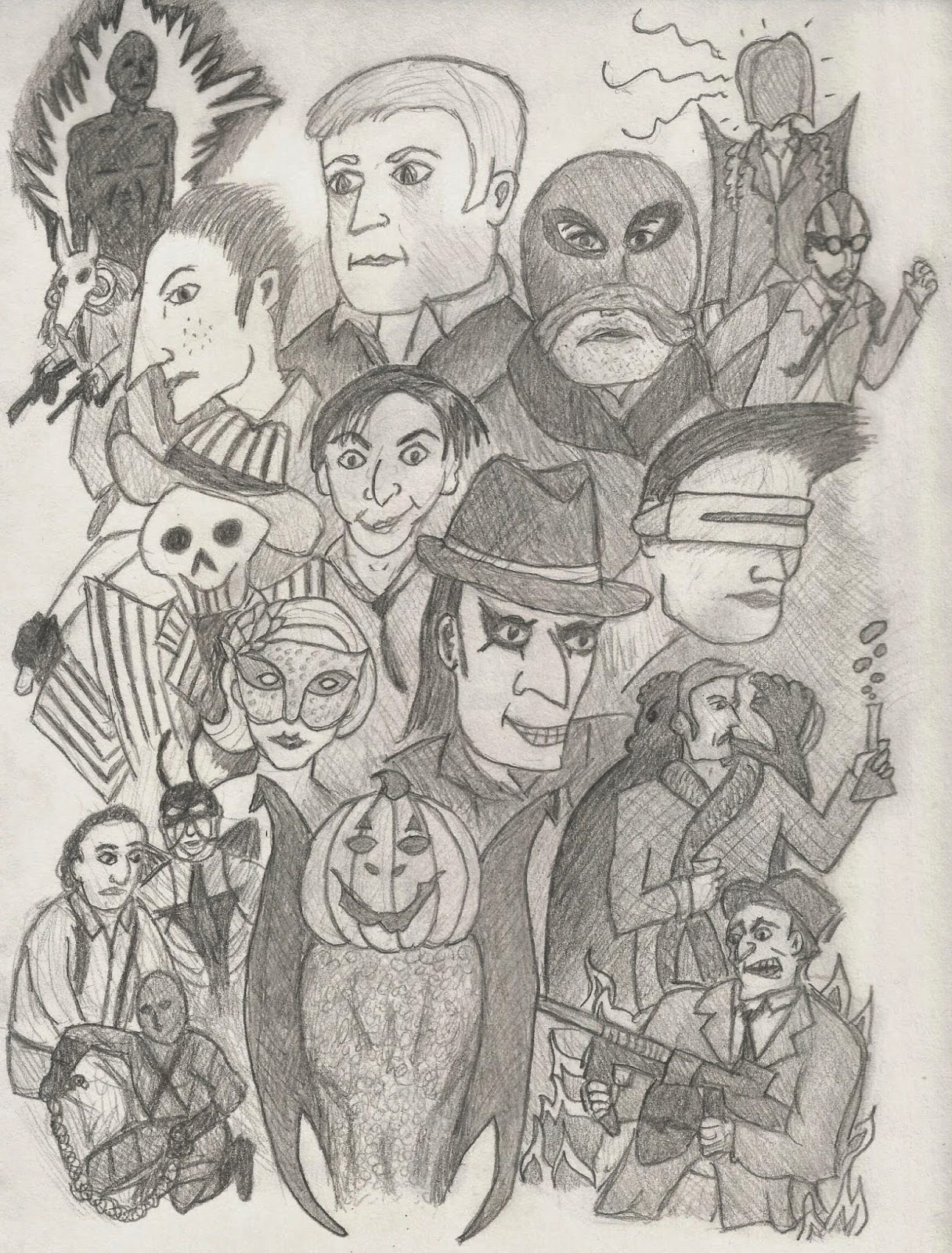
Here's a sneak peek at a serial I'm working on actualizing. This is concept art of some secondary characters who will end up being something like 1930's gangsters. I've been working on this image off and on for over sixteen months, and I've just now decided that I like the look of it. Leave a comment and tell me what you think. Would you watch a show with these characters? View on Tumblr.

Wednesday, December 10, 2014

Doctor Who Series 9 Wish List

I have 101 very important things I could be doing right now. Instead, I’m going to blog about Doctor Who.


Possible spoilers ensue.


This season, I want the TARDIS to be really, really crowded. I want the kind of family relationship that, in New Who, has really only been touched upon in series 1 (Nine/Rose/Mickey/Jack) and series 6 (Eleven/Amy/Rory/River). Thus, I propose a new TARDIS family.


Peter Capaldi as The Twelfth Doctor - I feel like Twelve hasn't gotten completely comfortable in his own skin, and that needs to happen in this season. And the best way to make that happen, I think, is to have him be surrounded by people he cares about. As well as trying to regulate his relationships with his friends, the Doctor needs to really buckle down on his search for Gallifrey. This is what he needs to do to finally have some semblance of peace of mind.


Alex Kingston as River Song - River is a brilliant character, and I know many people would like to see her come back to meet the similarly aged and grumpily charming new Doctor. The problem seems to be that we know exactly where she begins and ends; her story is bookended almost completely within the Eleventh Doctor’s run, and to delve into the stories in between would seem out of place and anticlimactic. That’s why I think the Doctor needs to do what he’s never dared to do before: bring River out of the library. I know this might seem to undermine tension that came before, but Moffat will find a way à la The Day of the Doctor. Here’s my rationalization. Due to Twelve’s recent muddy relationships with both Clara and Missy, he’s longing for a female presence in his life who he knows he can both trust, and who won’t be sexually threatening to him. A post-library River (perhaps even one whose consciousness has been placed in a lifelike robotic replica of herself) will be both ready to give herself to the Doctor completely, and will be mature enough to give his more sexually innocent incarnation space to breathe. She will be the heart of the TARDIS family, the person who the Doctor wants by his side when he finds Gallifrey.


Michelle Gomez as Missy - It is assumed that the Master escaped from Gallifrey itself, thus Missy should know its true location regardless her lie in Death in Heaven. The Doctor could reasonably ally himself with her, either through force or bargaining, and get her to lead him home. Missy would be the rogue of the family, never trusted, but kept around because she is simply the best option they have. She would also add an incredibly interesting element, since she could very well be both scornful of the idea of the Doctor having a family, while at the same time desperately wanting to be included in it.


Georgia Moffett as Jenny - The Doctor’s artificially created daughter, and one of the few Time Lord-ish beings left outside of Gallifrey, she could very well cross paths with her father after catching word that she may have a home to go to. After well over four seasons with no word from her, it’s about time that her presumably individual adventures come to an end, and there seems to be no better time than now, when what it means to be a Time Lord in this world is in question. She would add some much-needed innocence to this so far rather old and jaded family, being a relatively young person (I’m assuming the in-universe time since she last saw the Doctor would roughly relate to real-world time, or about seven years).


Craig Ferguson as The Human Scottish Bumbler - Not only a huge Doctor Who fan, but a long-time friend of Peter Capaldi, Ferguson is the missing piece of my series 9 wish list. He would be the particular friend that Twelve gets to bond with, someone who he can feel similar to, while at the same time still feel superior to. The Doctor always likes to have a human of Earth along with him, and it's very possible that he'd dip from Scotland both to find someone who shares his accent (aside from Missy), and to feel connected with his old friend Amy. Ferguson would add a fantastic sense of verbal and physical comedy to the family, he could play like a wittier, more vulgar Rory Williams.


Though I doubt many if any of these will be a part of the permanent upcoming TARDIS team, I hope all of them are eventually touched on, if not in this series, then at least in the next. I would just like some new (or relatively new) faces, and several of them, to pull this show out of threats of monotony. And think how fantastic it would be to see four or five names (and faces?!) flying through the time vortex during the title sequence!


Now a few words about Clara and Danny.


Clara may or may not be exiting in the Christmas special, and honestly I kind of hope she does. I like her character, but if she stays on for another series, she’ll have been the companion for longer than Rose, and as long as Amy, which just doesn't seem right. Her story seems to be at the point of reaching a satisfying conclusion (either in happiness with Danny, or her own death), and just the thought of another dozen episodes with her is extremely tiresome. In addition, I want a brand new character to come in soon for the Twelfth Doctor in particular to bond to, instead of being stuck with Eleven’s leftovers (Twelve and Clara’s superior chemistry notwithstanding). Unfortunately for people who think like me, Clara’s inclusion in series 9 seems inevitable. Whether or not she would fit well with the family I've laid out is up for discussion.


As for Danny’s potential as a companion, while I would like to see it, I’m ultimately against it. Even supposing that Danny a) will return from the afterlife in the Christmas special or beyond, and b) could ever be persuaded to travel with the Doctor after all the trouble the latter has gotten the former and former's girlfriend into, I feel like his story pattern would too closely match Rory’s (i.e. introduced in his first season as a recurring character and the long-suffering rightful lover of the girl caught between him and the Doctor, and then brought on as a regular in his second season with diminished romantic ambiguity) to be of much interest.


So that’s my over-long opinion. Thoughts?